
The Barbell Effect Comes for Media
don't hate the player, hate the game

Hey everyone — I came across a story this week that got me thinking about something I can’t quite shake: the state of media & content today.
I spent a good chunk of my weekend trying to make sense of it, and this post is what came out of that.
This week, Blockworks, a crypto company, shut down its newsroom and laid off its entire editorial staff.

When I read the news, my mind immediately jumped to the media landscape as a whole.
It reminded me of an episode of the Ben & Marc Show, where Ben Horowitz and Marc Andreessen talk about the Barbell Effect in media. The thesis is that media consumption is split into 2 extremes right now: very short, viral content and deep, long-form content.
If you map that Barbell Effect onto today’s news ecosystem, you see the same pattern. Audiences either want (a) short updates that spread fast or (b) deep, thoughtful storytelling.
Blockworks sits right between those two poles — solid, but stuck in the middle (aka ‘medium-market outlet’). They were fast, technical, and smart, but frankly just good enough to survive, not distinct enough to matter.
And, I just don’t see many benefits to being a ‘medium-market outlet’ at this day and age. I’m not saying this as a writer (yes, I’m calling myself a writer now), but more importantly as a consumer of content.
And the key point here is that as audience preferences shift, you can predict who survives and who doesn’t.
First, what exactly is the Barbell Effect?
This is a barbell:

The ‘‘Barbell Effect’’ says that in both business and weightlifting, the middle part gets squeezed. This means that in almost every industry, companies at the extremes, the big and the small, the luxury and the low-cost, tend to survive.
The ones in the middle? They’re the ones that struggle.
A quick example: Marks & Spencer
When I think of the barbell effect, I think of Marks & Spencer. It’s just very mid. It’s not something luxury, nor is it something very cheap/convenient.

Here’s what this retail barbell case looks like here:
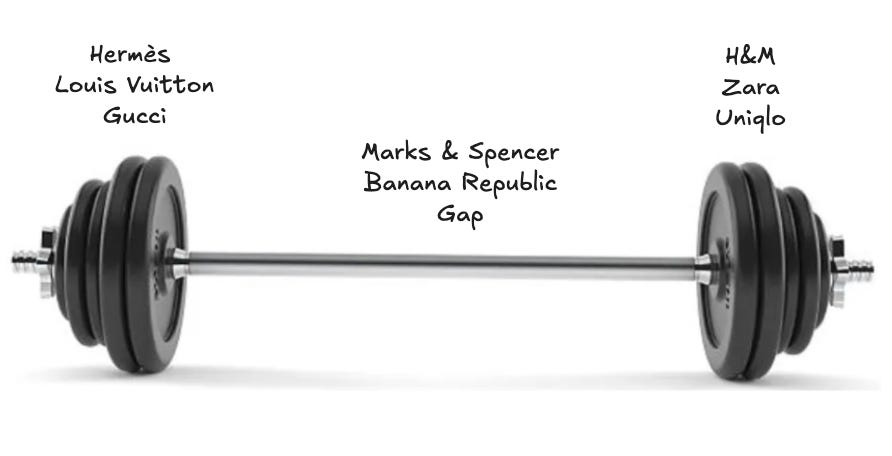
High End (Luxury / Premium): At the top of the barbell are brands built on luxury and exclusivity. Think Hermès, LVMH (Louis Vuitton, Dior), and Kering (Gucci, Saint Laurent). These companies thrive by selling fewer products at huge margins to loyal customers who want status and experience.
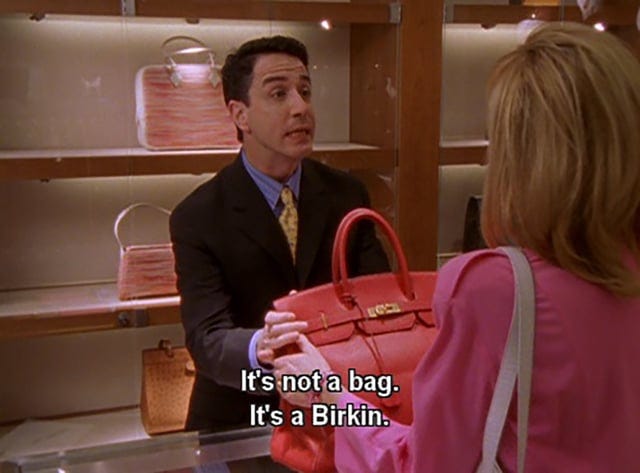
If everyone had a Birkin, it would not be a ‘‘Birkin’’ Middle (Squeezed): Then comes the “mid-market.” Think companies like Marks & Spencer, Banana Republic, and Gap. They’re not cheap enough to compete with fast fashion, but also not premium enough to feel special.
Low End (Mass Market / Fast Fashion): And then on the other side, you’ve got massive global chains that win through speed, price, convenience and trend. Think H&M Group, Inditex (Zara), and Uniqlo. They sell to everyone and move fast enough to keep up with what people want.
Ok, back to media.
Just like in retail, the middle is the danger zone. That’s exactly where most outlets — including Blockworks — have been sitting.
Blockworks was pretty high on my list of favorites. But if we’re being real, they lived in that middle space: not a giant like Bloomberg or Reuters, and not a niche newsletter either.
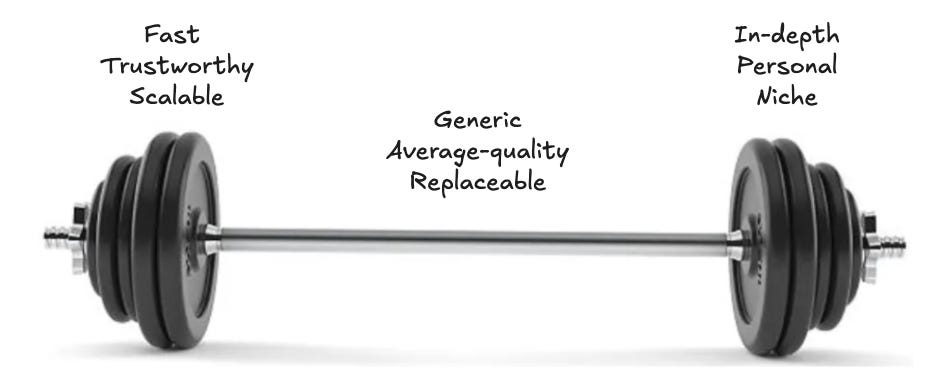
People want either:
(a) content from huge, established sources (with reach and credibility), or
(b) content from independent creators they trust personally.
Everything in between, the “almost big” outlets that rely on the same recycled topics and formats, are getting squeezed out.
But— Why?
Simple: distribution + algorithms
For a long time, the middle in media worked. You had the big outlets with reach and credibility, the small blogs and newsletters with personality, and a whole layer in between (the not too big, not too small — something like a local new outlet).
That model depended on people going to media. You’d type in a URL, check a homepage, or follow a publication directly.
Now the flow is reversed.
Media/Content comes to people. Rarely do people go and search a news website, they get it through feeds, aggregators, and algorithms. Once that happened, the middle started losing its edge.
Big brands still win because they’re recognizable + reliable.
Small creators win because they feel personal + human.
The middle doesn’t have either advantage. It’s not big enough to dominate distribution, and not distinct enough to earn loyalty. I’m more than happy to buy a t-shirt from my favorite niche newsletter ,but I’m not going to buy a branded t-shirt from a mid-tier media outlet.
This trend accelerated with AI. In a world where AI can generate an entire article in 30 seconds, the “middle” becomes even more vulnerable. Because when anyone can produce average-quality, “good-enough” writing, the question becomes why would you read a mid-sized outlet at all?
So, we kind of stopped needing the middle.
Here’s What the Data Says

You don’t need to take my word for it — the Reuters Digital News Report 2025 shows just how much audience behavior has shifted:
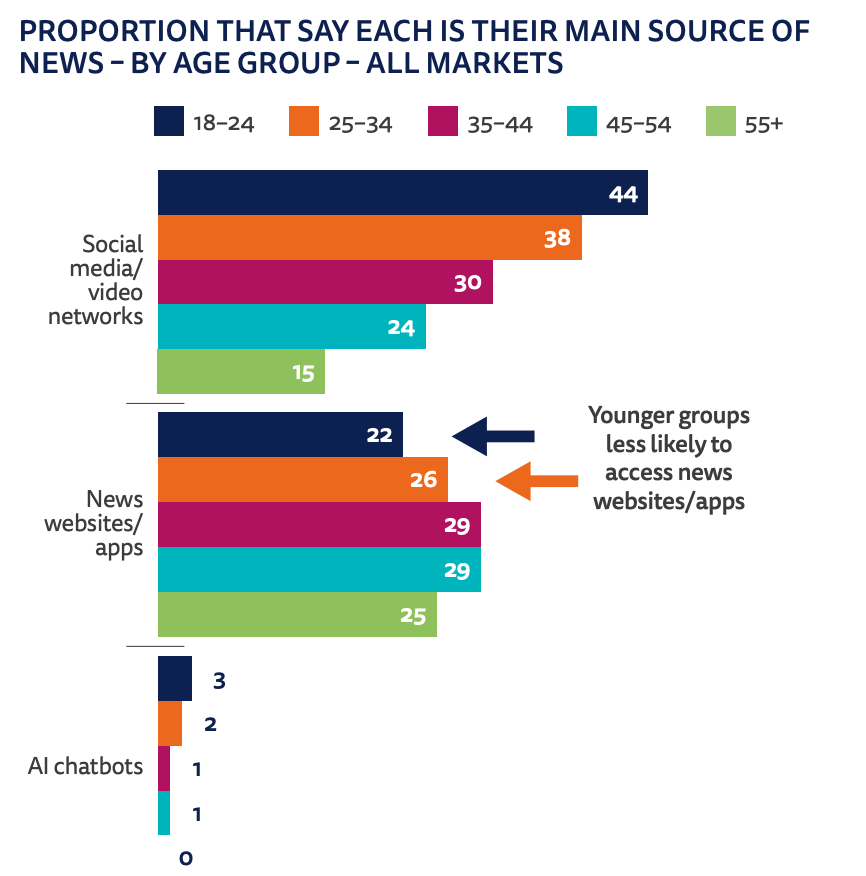
Younger people aren’t really checking news sites anymore.
Only one in four under-25 say a news site or app is their main source, while almost half say it’s social or video.
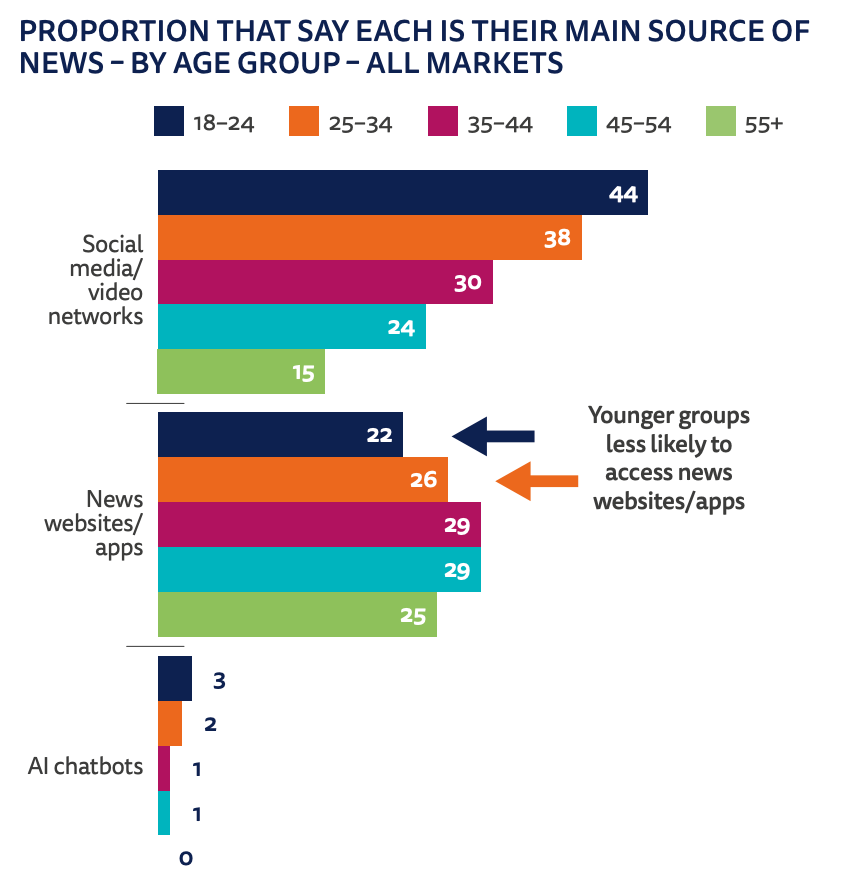
how is ai chatbots % so low? Traditional outlets are “losing out to online creators and personalities.”
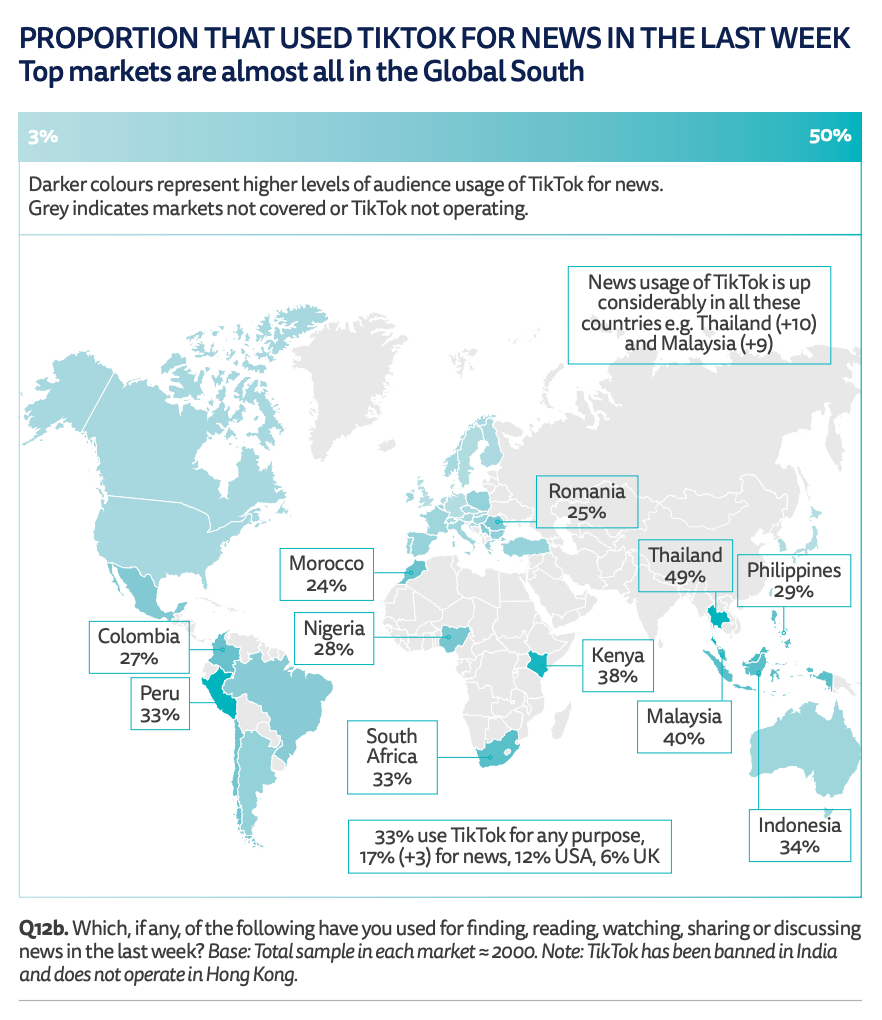
People are more likely to watch a TikTok explainer from a creator than read a mid-tier article covering the same story.
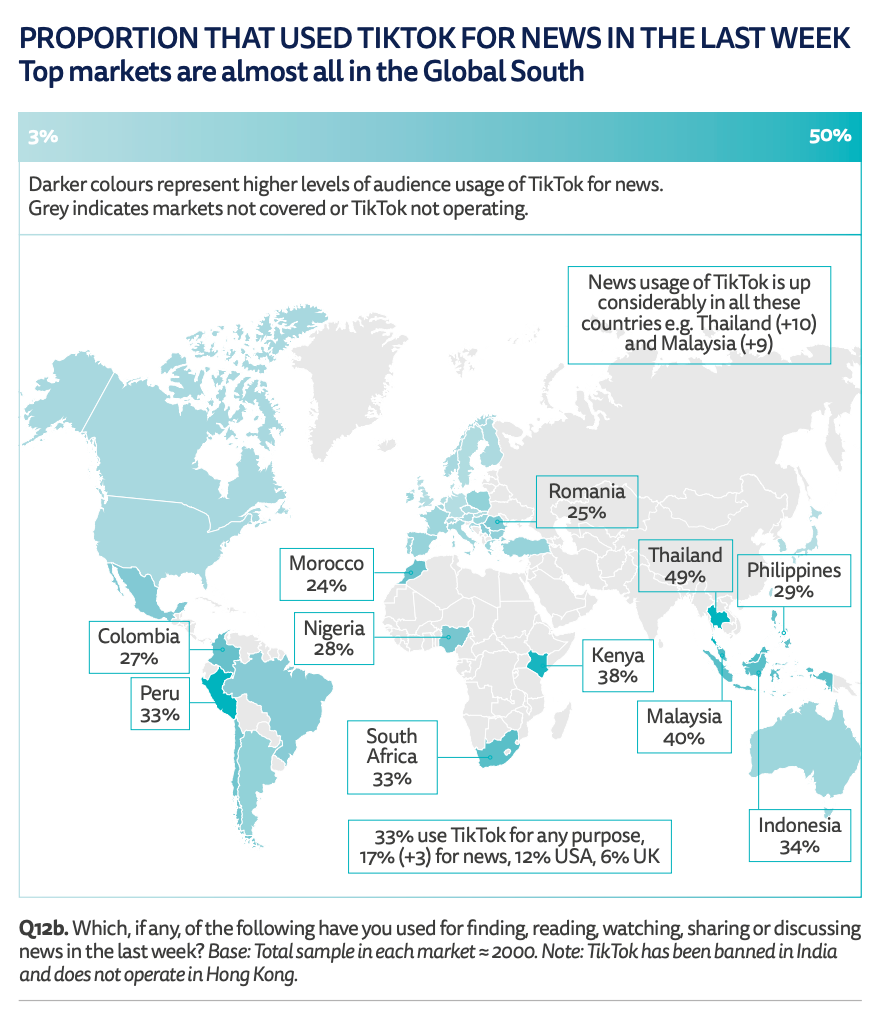
half of Thailand rely on TikTok for news?!
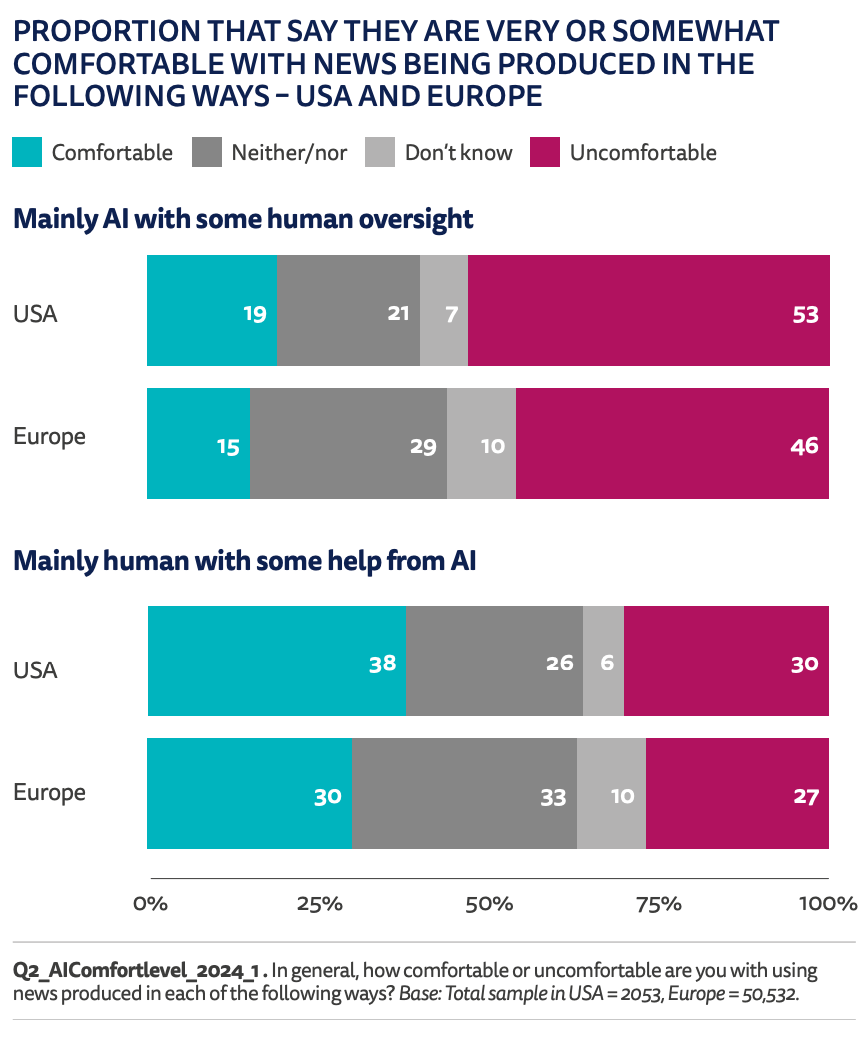
Audiences are skeptical of AI-written news.
Reuters found that people are still uneasy about fully AI-generated articles. So while AI makes average content easier to produce, it also raises the bar for the content itself. Good-enough might no longer be enough to survive.
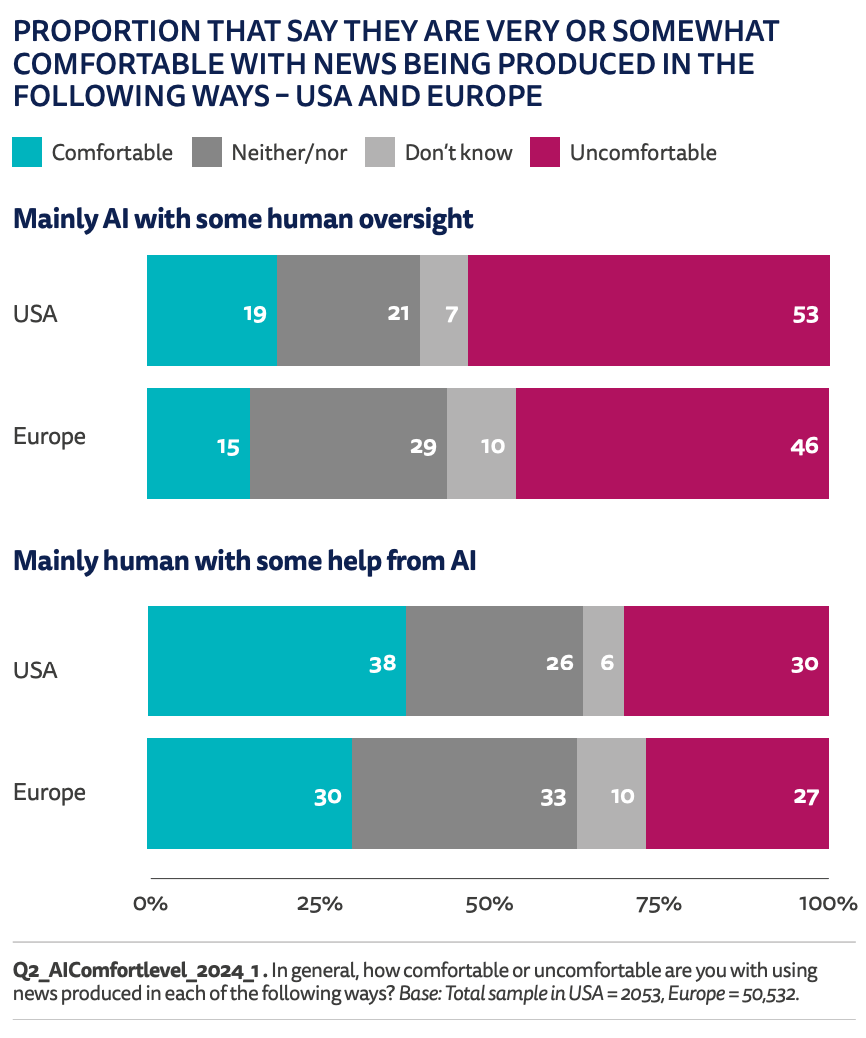
I see 0 reason to not use AI as an intern editor for my posts
Even local news, which used to feel safe, is fading.
People say they want it, but most now get local updates from apps or community pages instead of local news outlets.
Cut to the chase.
It’s clear the internet doesn’t need more “middle.”
What people really want is either scale or soul — something massive enough to feel reliable, or personal enough to feel human. Everything else is just replaceable.
In the end, the Barbell wins. The middle gets squeezed, and attention drifts to the edges.
We’ll see how it all plays out in the long run. People love to hate the X algorithm, and no one wants to admit they live in an echo chamber — but that’s the world we’re in.
must read for anyone trying to create content in 2025. thank you 🙏
The LVMH example is perfect because it shows how the barbell isn't just about price points, it's about value propositions that resist commodification. When you're selling a Birkin or a Dior experience, you're immune to the middle-market squeeze because scarcity and status can't be AI-generated or algorithmically replicated. The Blockworks shutdown is basically the media equivalent of what happened to Gap and Banana Republic, stuck between Bloomberg's institutional trust and niche newsletters' personal connection. What's wild is that LVMH understood this barbell dynamic decads ago, which is why they never tried to chase volume at the expense of exclusivity even when the temptation was there.