
Storytelling: An Engineer's Superpower
But most people don't know what it is

Hey everyone — it’s officially winter, which also means bulking season. Sweetgreen, Chipotle, and Starbucks are clearly doing their part to help maximize your protein intake.

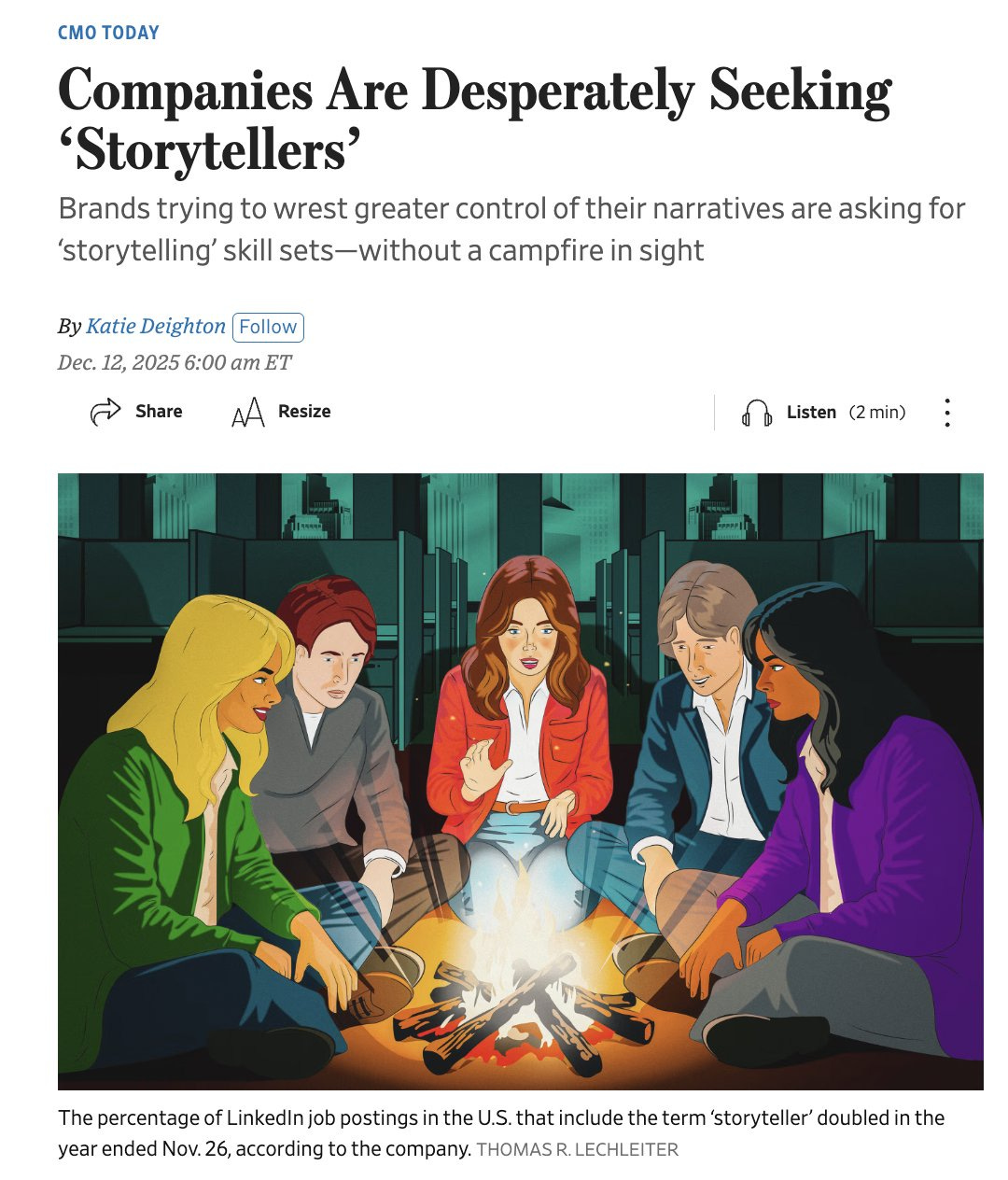
This week I learned that everyone has opinions on storytelling. It all started with this WSJ article: “Companies Are Desperately Seeking ‘Storytellers.’” The conversation that followed was pretty interesting—most people seem to agree that storytelling matters, even if they can’t quite agree on what it actually means.
Everyone Wants a Story. No One Knows What That Means.
I’ve been thinking about storytelling (even if it wasn’t word I was using here) for a few years, particularly when I got into crypto. I got in pretty late, which to this day surprises me because I was studying Computer Science and Economics when it started to become popular—seemed like the obvious fit in retrospect. But the problem was that Ethereum had a terrible narrative and I was not at all interested.
The narratives you’d encounter were: (1) it’s a scam (which, fair, a lot of it was), (2) ultra-complex technical jargon that meant nothing to most people (even someone in computer science) or (3) the “we hate banks, build our own nation” anarchist/decentralization-maxi angle of ironically wealthy/well-off people. None of these made me want to look deeper.
Then enter covid. A lot of time in hand meant I could actually spend more than 5 min to understand. And I realized Ethereum—and crypto more generally—was actually way more interesting than any of those narratives. It’s in its simplest form technology that lets you do interact without intermediaries. Not a scam, not anarchist revolution, not ‘revolutionary’ tech magic, just a different way to coordinate online using technology. But no one was explaining it like that.
Since then, I’ve been trying to explain crypto/tech to everyday people: simply, without jargon, and in a way people can relate to.
To me, this kind of narrative-building is storytelling. The outcome is getting people to pay attention to or act on a new product/belief/way of doing things.
The WSJ article put more words and data around this: companies need storytellers. If Ethereum had better storytellers, I’m sure that more people would have paid attention earlier (arguably still true today).
However, I also think the role is often misidentified, and Twitter/X seemed to confirm that most people don’t actually know storytelling means and where it fits in an organization.

So here are my takes on what storytelling actually is, why it matters + how to think about creating your ‘‘story’’:
What + Why:
Storytelling is the why.
Your story/narrative needs to answer why your product exists and why anyone should care. It’s not what you build, or a list of features.
In tech, storytelling is technical. 100%.
It’s not algorithms or code, but yes, it IS technical. You need to explain complex ideas in ways that make sense to people who are and aren’t technical.
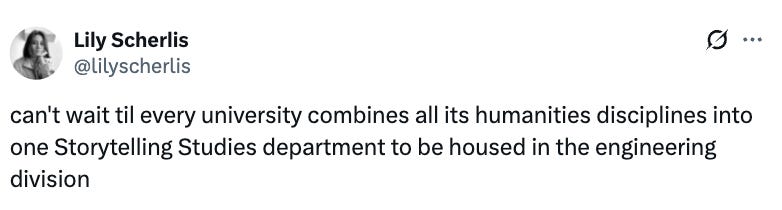
on point take
Storytelling is NOT marketing or sales.
Marketing is about reach, metrics, conversion rates. Sales is about closing deals. Storytelling is the foundation for marketing and sales possible.
In tech storytelling is technical! It should fit in product, engineering and must be started by leadership. An engineer who can explain is one of the most sought-after skill—I truly stand by this.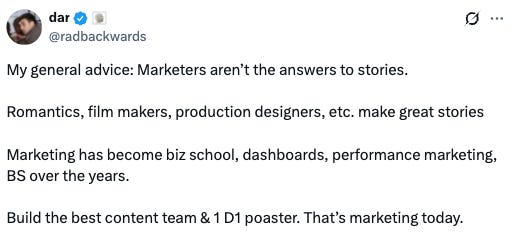
Storytelling is NOT a one-day thing.
You can’t outsource your core narrative to an agency and expect it to work long-term. Of course get help, but given the rise of ‘‘founder-led’’ initiatives its obvious to me that its the way forward.
“The most elite storytellers are founders.” I love this take. Founders live and breathe the product. They know the struggles, the pivots, the vision, the why behind every decision. That authenticity is nearly impossible to replicate.

How to create your story (not a runbook some rules I live by):
When crafting your story assume people know nothing.
It’s not that people aren’t smart, they are —and you probably want the smart people to care, but they might just not know or simply might not care yet. Don’t assume context. Don’t assume interest.
A good default mental model: You care a lot → they care zero
Start with the human, NOT the product.
It’s not about your product!It starts with:
“Here’s what people do today”
“Here’s why that’s annoying / broken / inefficient ”
Better stories → empathy. Most bad storytelling skips this step and jumps straight to “here’s what we built.”
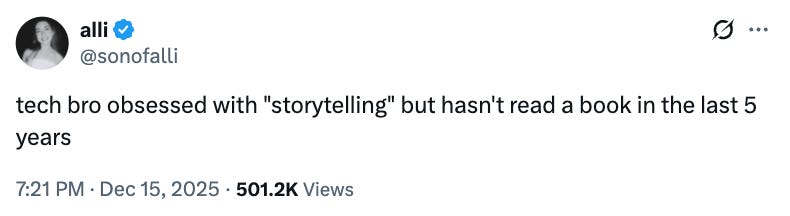
I feel like a parrot repeating the same thing but to be a good storyteller you need to read fiction. Repeat the same story everywhere (yes, it will feel boring)
A common trend I see is trying to make new content constantly. You probably don’t have a content problem. You don’t need a new story every week. It’s about telling one coherent story consistently.
I made this mistake when I first started content creation, its exhausting and isn’t even the problem in the first place.Yes, saying the same narrative will feel repetitive. That’s kind of the point.
Not everything will work, and that’s okay.
Trial and error. What really works all the time anyways.Tell story → watch confusion → adjust (in a loop)

Final Thoughts: If you get the story right marketing gets cheaper, sales gets easier, product knows what to do, engineering is more motivated. I can go on.
That’s all for this week - I’ll surely be thinking more about storytelling. My next post will be somewhat of a year analysis, possibly of this newsletter. I’m committing to it with this.
i remember thinking “damn i think i understand what she says” when i heard you explain a super complex technical concept in crypto on stage back in 2023.
you are the best crypto storyteller i know, and the industry definitely needs more people like you. 🧿